Most natural lakes with good populations of panfish have some areas with shallow water which typically coincide with weed growth. These areas, whether they be shallow bays or large shallow flats, need to have a soft enough bottom for good weed development. Also note that shallow can be relative to the lake. On some particular lakes, the deepest part of the lake might be ten feet deep, and shallow might be five feet. Other lakes might be fifty feet or more and shallow would be considered ten feet. On some particular lakes, the shallowest structure might have a harder bottom. Not to say that panfish don’t use rock and hard bottom areas because they often do and that can be an important type of structure at different times, but I often find that early ice is often all about soft bottoms and weeds.
These locations are important for panfish but also important on early ice because shallow water and shallow bays in particular often develop ice faster and these are often the safest areas early in the season. My favorite areas to look for when looking at a contour map of a lake are bays or expansive flats that range between 6-13 feet that have a soft bottom and abundant weeds. These locations can be small ranging an acre or two, but I find that small locations that are easy to access simply get fished out quicker. Larger spots can simply hold more fish.
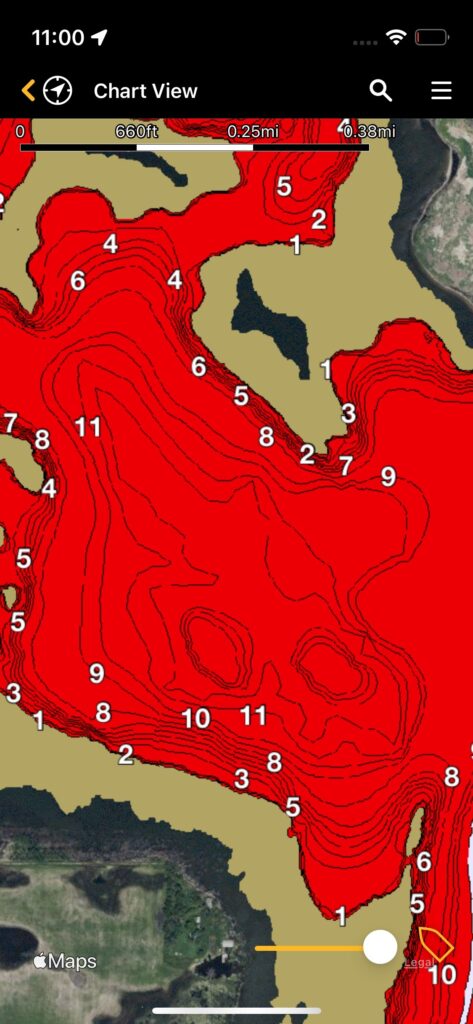
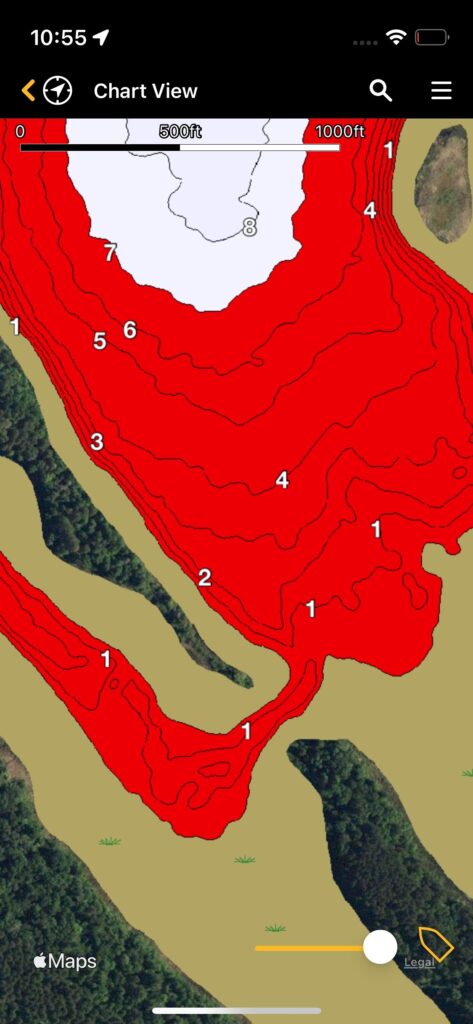
Here is the “X factor” however when looking at these types of locations. Within these shallow bays or across these large flats, if there is any type of depression, trough, dip or bowl with slightly deeper water… these locations are fish magnets come early ice. If this depression is big enough and deep enough, you could almost consider this structural element a secondary basin and these locations become really obvious. This could just be a twenty-foot depression or secondary basin within a bay that is isolated from the primary basin on the main lake body. These secondary basins are good, but the sweet spots don’t have to be as significant or as obvious. If you have a shallow seven-foot bay that is full of weeds, simply finding a trough that is a foot or two deeper within that flat will often load up with fish. Sometimes these deeper depressions within the flat will show up on a good lake map but sometimes they don’t. When you can find these sweet spots however, they will typically be good year after year.
Something else to consider when panfishing early ice is to look for shallow flats and bays that have a lot of weeds. At early ice, especially when the ice is clear, you can do a tremendous amount of recon work that will not only benefit you that day but for weeks to come. Walk around and look for weeds frozen in the ice. You should be able to get a good visual picture of weed clumps, where weeds start or stop and if there are any open lanes or gaps in the weeds. If you can find major weed clumps and find openings or edges, hit waypoints and essentially map out the weed growth. Early ice is one of the best opportunities to do this because once there is snow on the ice, this opportunity is gone. Setting up adjacent to some of the largest and densest stands of weeds can result in a high batting average. The only thing better most days is finding these weed clumps adjacent to any type of bowl, dip or trough that we outlined earlier.
Realistically on many lakes, these types of locations are the hottest option around just because this type of location often coincides with some of the safest ice and these locations can often be realistically one of the shortest walks. Logistics play a factor at early ice especially when we are walking out and towing our gear by foot. Also note that some of these depressions or areas with slightly deeper water within this shallow water can be obscure on some lake maps. Shallow water less than ten feet particularly with a soft bottom are often not mapped with as much detail. If there is any indication of a contour line, check it out. I find that these locations are extremely productive at early ice and often produce but also note that these secondary basins and dips or troughs only hold so many fish and once the population of fish gets beat up, these spots also don’t recharge with new fish as well as some other locations. This is why early ice can be so important. Once fish go home in a bucket, the spots get worse. The fish get smaller and there is less competition.