Since its inception, forward-facing sonar (FFS) anglers have been modifying their set-ups with varying preferences. Rigging a pole system at different sides of the boat or running multiple screens and transducers at once are a few common systems. The standard, however, remains running the FFS transducer on you bow-mounted trolling motor to scan while you work forward across an area.
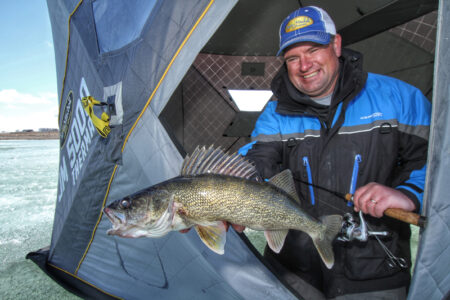
Jason Mitchell is well-versed in the use of forward-facing sonar technology. He shares his tried and tested settings for simple and effective use of these game-changing electronics.
One key benefit of using FFS, such as Lowrance’s ActiveTarget shown here, on a bow-mounted trolling motor is the freedom it provides for hands-free operation while fishing. With just your foot, you can pan around and scan the trolling motor and FFS transducer quickly and line up and make your casts simultaneously.
Regarding the best settings, Mitchell uses his ActiveTarget in forward view with a range set to 70 feet. This will allows you to look ahead at a distance to avoid spooky fish and see them before they see you. To level out the view without having to manually adjust the angled transducer on the trolling motor, Mitchell turns the “Stable View” setting on. This makes it much easier to identify fish on the screen.
As a bonus tip, Mitchell stresses that one of the hardest lessons he’s learned with forward-facing sonar is knowing to go against the age-old adage of “never leaving fish to find fish.” FFS can show you a lot of fish in a particular area but sometimes you have to leave fish to find ACTIVE fish.