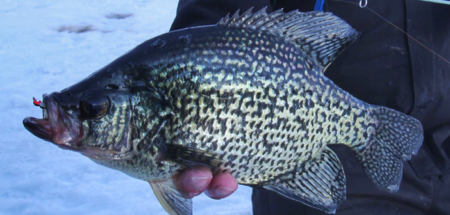

In this video Jason Mitchell explains what anglers mean when talking about crushing a wax worm. It’s a phrase some anglers will throw around, and basically they are just squishing the waxworm to get the juice out. What it does is give the waxworm a very delicate action and it adds a lot of scent to the water too. With bluegills, you have to think delicate action, especially with big blue gills. Everything has to be right. You want that jig to just float without spinning. So when you crush a waxworm is just pulsates, and almost dances.
Using a spring bobber lets you accomplish this action much easier than a normal ice rod tip. It allows you to make that bait quiver using that spring bobber. The cadence is a quiver, quiver, hold, quiver, quiver hold pattern. Not an aggressive jigging pattern. It’s more of vibration, where you’re just letting that rod tip and spring bobber shake like a bug, imitating a back swimmer or insect swimming through the water.
Spring bobbers are not just a strike indicator. It has a huge influence on your presentation in the sense you can take a straight rod tip and do the same quiver action mentioned above and it’s going to give that jig a lot more bump. Whereas the spring bobber subdues that motion where it causes that jig to swim, gives a little bit more of a natural bug. A bait or lure’s appearance in the water is so important for catching these big blue gills.