4 top ice guides reveal secrets for diabolical mid- to late-ice walleye bites
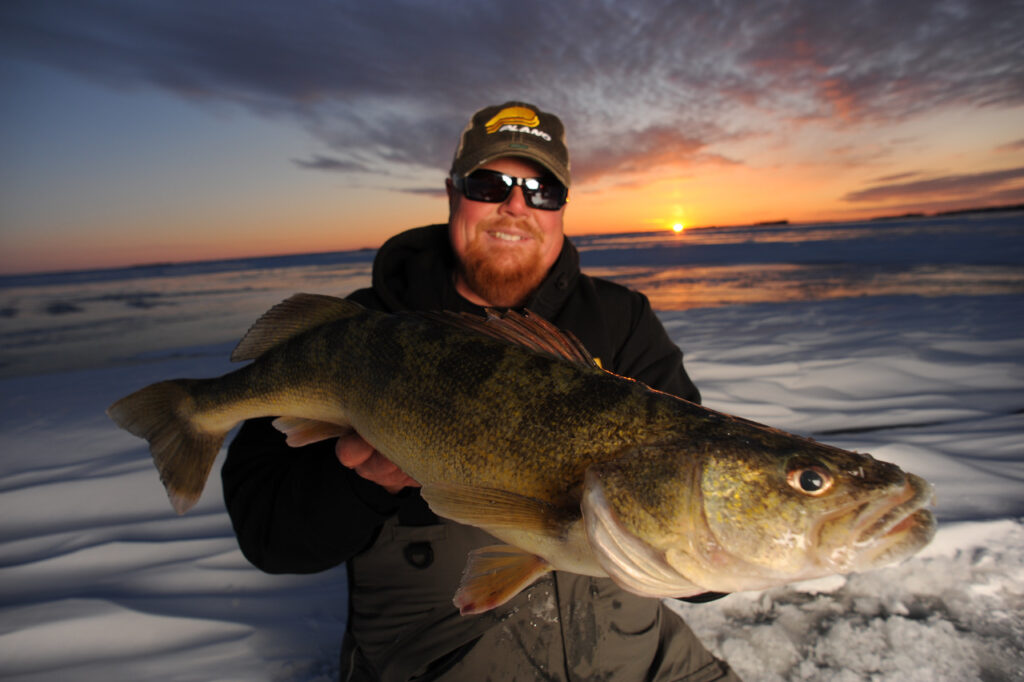
Right now, ravenous packs of marble-eyed wolves are patrolling underwater woods, some on the edges, others in the darkest recesses of brush and bramble. And on top of the ice—armed with stout sticks and winch-worthy line—some of the Ice Belt’s most savvy anglers are fishing for these hungry ‘eyes over the kind of skinny water and gnarly cover that may seem counter-intuitive to more traditional ice anglers.
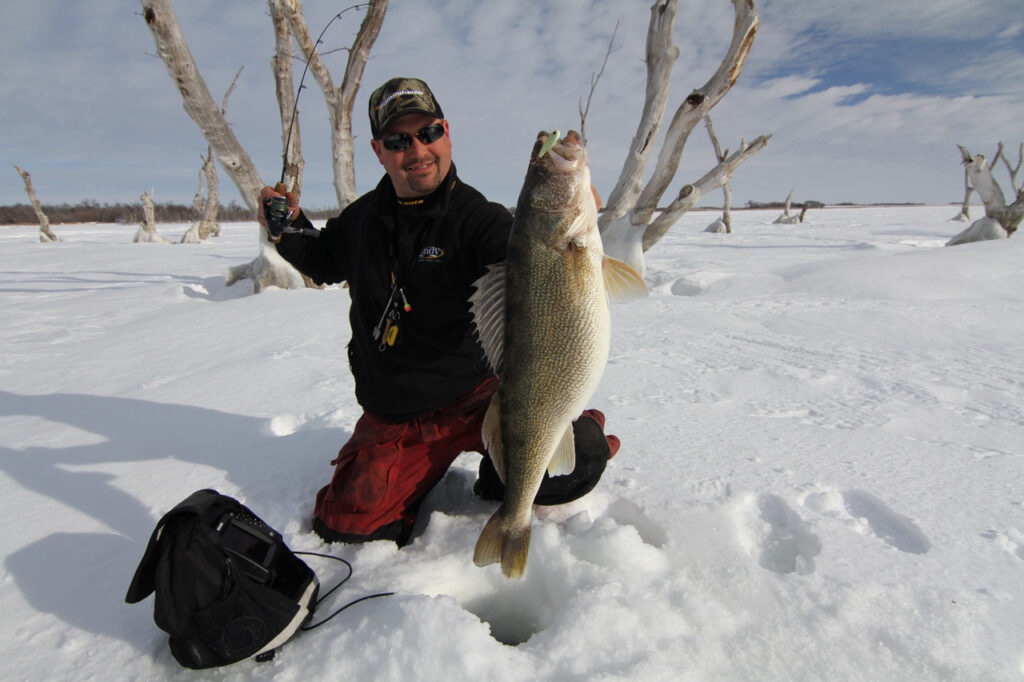
Yet, from the river backwaters of Illinois, Iowa, Nebraska, South Dakota, Minnesota, and Wisconsin, to the ultra-fertile Glacial Lakes of Northeastern South Dakota and the wood walleye capital of the world, Devils Lake, North Dakota, opportunities abound across the Ice Belt to catch walleyes in and around wood in winter—and shallower than you might think.
Fact is, wood deserves more exploration on natural lakes and reservoirs, too. As textbook spots receive more pressure, seems more anglers are discovering walleyes in unusual places. But, if there’s cover and food there, what’s so odd? The argument could be made that wood has simply been under-utilized in favor of rock piles, points, weed edges and breaks for decades.
Drop an underwater camera and you’ll be surprised by the abundance of life. From wood-clinging brine shrimp to minnows and young-of-the-year perch – timber often teems with activity, especially when weeds have died and many main basin or river channel areas are vacant.
For retired Devils Lake guide and host of JMO Outdoors, Jason Mitchell, wood is an all-winter staple, not just an early- and late-ice pattern. Similarly, it’s not just a place to set up during prime time. “On Devils Lake in particular, I’d say 80% of my 25-plus-inch walleyes have been caught in waters eight feet and under, typically in wood. You might catch a fish every five minutes in the morning or evening – but the action can continue during the day with a fish or two an hour and an afternoon flurry. I think that’s where guys go wrong. It can be 20 to 30 below zero in mid-winter, and I’ll be in 5 feet catching big walleyes during the middle of the day. There are resident wood fish on a lot of waters. And a lot of times these wood walleyes are big fish. The food and ambush opportunities are just too perfect.”
Professional walleye angler and fellow Devils Lake guide Johnnie Candle agrees. “There’s no doubt about it. Just like weed walleyes, rock walleyes and mud walleyes, there will be fish that just stay in the wood because they have everything they need.”
Choose Good Lumber
Stands of submerged trees and deadheads, stump fields, laydowns, brush piles, and fence rows can all hold walleyes in the winter. Especially those areas of wood with hard bottom transitions of rock and gravel, and, if you’re lucky, some remaining green weeds. Yet, talk with some of the best wood-workers on the water and they’ll tell you not all lumber is created equal.
“Good luck just randomly drilling holes in a stand of wood that extends for hundreds of yards,” says Minnesota-based walleye guide Brian “Bro” Brosdahl. “Typically, I like to find shoreline brush on the edge of cattails, or, in rivers and reservoirs, I will gravitate to cedars and willows. Of course, on a lake like Devils Lake I beeline to the buckbrush, which holds hordes of walleye food, from invertebrates to minnows to young perch. And, in some waters – like Lake Oahe – you’ve got cottonwood trees in waters up to 80 feet. The tops of the trees might come up to 30 to 40 feet, and that canopy can hold a ton of fish. But most of my wood walleye game is done much shallower. My favorite is newly-flooded timber and brush. That’s what makes Devils Lake such a truly awesome walleye fishery. There’s literally hundreds of miles of this kind of habitat, although I like to focus on isolated, small patches of wood. Find trees that are eight to 10 inches in diameter with a lot of branches and fresh bark. The bark is important because the brine shrimp cling to it, which drives in minnows, perch and walleyes.”
While Mitchell often targets areas of buckbrush, he says smaller trees like Russian Olive and Chokecherry bushes also provide good winter walleye habitat.
“Devils Lake has risen over the years very gradually and with it, more timber is knocked down by the ice in the spring each year. So, most of our flooded timber is in water less than 12 feet near the shorelines, precisely the areas I seek out once the lake freezes. Sometimes I’m fishing in as little as two feet of water.”
Candle: “I’ve had some good luck fishing over the tops of buckbrush and Chokecherry bushes in 10’-14’. Seems like positioning baits right above it is key, so the fish cruising around can see your bait. It holds fish, there’s no doubt about that. It’s a great place for bait to hide. They bury in there in the wintertime, just like they do in the summer. But it’s tackle-eating stuff.”
Scouting High-Probability Contours
Bottom contours have to fit a certain set of criteria, too, for walleyes to favor one woody area over another. To find these optimal spots, an angler either needs high-definition GPS lake mapping via the SD cards and smartphone apps available from LakeMaster and Navionics for real-time winter fish-finding – or a set of waypoints created during the open-water season. In a perfect world, best to have both.
“Open-water scouting maximizes your time on the ice,” says former PWT champ and Devils Lake guide Jason Feldner. “In the summer and fall I spend a lot of time watching my Humminbird Side Imaging. I set it to look 50 feet out to each side of the boat for maximum detail and I drop waypoints onto my LakeMaster map when I see wood around good depth transitions, typically edges with quick access to deeper water. A lot of these spots used to have standing wood, but now it’s all lying down because of ice, wind and wave action. My best spots also have rock and gravel. Find both and you’ve got a goldmine. I just mark ‘em and go back and fish the areas in the winter. Otherwise, you’ve gotta drill too many holes to find the spots.”
Candle: “The visible timber on Devils Lake is fading fast. We had a lot of timber that you could see with the naked eye years ago but now the ice has lopped off the trees at the surface and some of the timber has literally been uprooted by the rising of the lake. But idle around with Side Imaging in your boat and you get a really good idea of where the wood, inside cups and points are. Come winter, I load my LakeMaster card with waypoints, pop it in the unit on my ATV, and drive right to the waypoints.”
When it comes to scouting, Jason Mitchell says “old-school” works. “I learn a ton from standing on the front deck and glassing areas in my polarized sunglasses. You’ll find a lot of stumps, but what you want is the bushier stuff, laydowns and branches. Then find an inside turn or a little trough or opening; that’s the most critical piece of the puzzle. Then I mark waypoints on my electronics based on what I see with my own two eyes.”
For Bro, the structure underneath the wood is key. “I like that hard to soft bottom transition stuff. Then, is there a saddle or bottle neck? You could be in the middle of forest of wood scratching your head, but if you look for where the wood thins out over a saddle or hole – or little ditches inside the brush – those make the best waypoints for winter.”
All of these anglers agree that subtle shallow-water contours are largely overlooked by ice anglers. Bro suggests anglers look for spots that have been dug out by wind and wave action. “You might find a little finger near shore that only changes a foot in depth but will hold tons of walleyes. Keep in mind that most of the dramatic contours get hit by the cartoon-watchers, fishermen that bee-line to every textbook piece of structure on the lake, eyes glued to their digital GPS maps. So, a lot of your formerly A-list textbook spots just aren’t primary structure anymore. Find those B, C, and D-list spots. Those are the new gems.”
Mitchell says that with all of today’s fancy electronics anglers have forgotten to watch the shoreline for topography changes.
“A lot times you can look at the shoreline and determine if the woody area offshore will produce fish. For example, is there a sharp bank or cut bank? A lot of my favorite locations are where an inside turn or deeper water comes close to shore. Fifty yards from shore it could be 12 feet, but then there’s one spot where there’s an inside turn or trough, where deeper water cuts close to shore. Those produce.”
Mitchell is also big on areas of wood with sand or rock bottom. “Look for where wave action has pushed sand into a little lip on shore. Might be 4 feet then drops into 6 or 7 and then tapers off. Again, dynamite.”
Candle says that whenever he can find two types of cover or structure that butt up against each other, he consistently catches walleyes.
“If you can find the flooded roads that used to follow the edges of timber you’ve got a slam dunk because you’ve got two reasons for the fish to be there. Or anytime you’ve got rip-rap that butts up against trees, that’s another slam dunk. There are lots of these areas around Devils Lake and they’re not hard to find. Most of them you can kind of see above the water.”
Feldner reiterates that a solid bet is any point with wood on it close to deeper water. “Early in the season we’ll fish shallow in 4-10 feet of water. I’ll focus on the north or northwest side of wood where our prevailing winds wash up rock and gravel along the edges.”
Then, as the ice season progresses into February, Feldner will jump between deeper contours and wood edges. “The walleyes won’t move far – maybe out into 14- to 18 feet of water – but when it warms up, they’re right back along that wood edge or tucked a little bit inside. Then, the closer we get to spring, the more walleyes you’ll find in and around really shallow wood as they start migrating along the shorelines toward spawning locations. That can be an incredible bite, especially when we have late ice.”
‘Deer Hunting’ Walleyes
Feldner, Mitchell, Bro and Candle all agree that ice anglers would be a lot more successful if they fished walleyes like they hunt deer.
“If I’m fishing in a narrow area I want to look for open areas or edges where the fish can pull up. Think of your hole placement like where you’d put a deer stand. Look for funnel areas, points or saddles that lead to a hump – places where fish fun to head to a particular piece of structure. What I like is when you’ve got a straight contour on your LakeMaster chip – say 10 feet – and it makes a sharp dip in and comes right back out – that makes a good pinch point for those fish,” says Feldner.
Mitchell adds: “Ask yourself: Where are those fish resting? Where are they feeding? A lot of times, in the wood, that’s where.”
“And where you drill holes is a lot like cutting shooting lanes. Sometimes you’re gonna shoot that .35 Remmy in the brush, but if you’re smart, you’ll plan ahead, and drop some lines in open areas where fish can see your bait from adjacent cover,” says Bro.
Pro Presentations
In North Dakota, anglers can legally cover wide swaths of frozen water with a combination of four tip-ups, dead sticks and jigging rods.
“It can get dicey with a lot of lines out. These fish mean business and will bury you in wood so fast it’ll make your head spin. In my experience it doesn’t really matter if I have one line down or four. Say 15 walleyes move through, you’re going to intercept one. Instead of setting out more lines, I’ll just hole hop. I fish one bait aggressively and shoot to kill,” says Mitchell.
However, other anglers – like Bro – will use multiple lines as a scouting tool. “I’ll find an area that’s just far enough from wood that I don’t get hung up. Then I’ll use deadsticks or tip-ups like mouse traps in the open areas to tell me where walleyes are moving through. Whether it’s a tip-up or dead stick, I simply place a split shot six inches up from the fathead to pin it in place and we call it a day. I’ll jig another hole closer to wood with a rattle spoon and minnow and then if a tip-up goes off, I’ll move everything in that direction.”
Feldner: “I like to drill 10 or 15 holes once I mark these spots and do some hole-hopping and put a few tip-ups out. You know the deal: Some days you can catch a whole bunch of fish out of one hole and three feet away only catch one. So, if I start getting bit on tip-ups I’ll go over, land the fish, and start jigging there. The tip-up deal is pretty simple – fathead minnows 6- to 8 inches off the bottom. Of course, the problem with tip-ups is a lot times the walleyes will run you down into the trees and you’ll get snagged. That’s why I pretty much use them as scouting tools and go back and jig, watching the screen on my electronics, set to graph mode and 2x zoom. Definitely helps me jig the top of the wood without getting snagged.”
Along these lines, Mitchell says most anglers use gear that’s too light for wood walleyes. “I’m out to cross that fish’s eyes and give him the headache of his life. He might get one or two shakes but that’s it. So, every part of the system has to be about big torque – from the hooks, line, to the rod and reel. Fish either come up or it’s a battle. For starters, I’ll take a glide bait and move the treble hooks up a couple sizes. Most of the time that’s connected to 14-pound braid, sometimes even a 20-pound fluoro leader. The rod’s gotta have balls, too. Too light on the tip and I’ll roll a lot of fish. A 30-inch medium-heavy walleye rod with some backbone is a good choice. Think of it like flipping for bass through the ice. Get that fish out fast.”
4 Mistakes To Avoid For More Wood ‘Eyes
- Limit vehicle noise. Park a good distance from where you’re going to fish.
- If a fish leaves the transducer cone of your electronics, DO NOT stop jigging. Walleyes will often move several feet off to the side of the bait (and outside of the cone) but rocket in and smoke it if you keep working the bait.
- Don’t leave a spot too early. Just because you don’t catch a fish the first hour, doesn’t mean the fish aren’t there. It can also take fish awhile to re-acclimate to the area following the noise of shallow-water drilling.
- Spend the peak morning and evening hours fishing, not running around drilling holes.