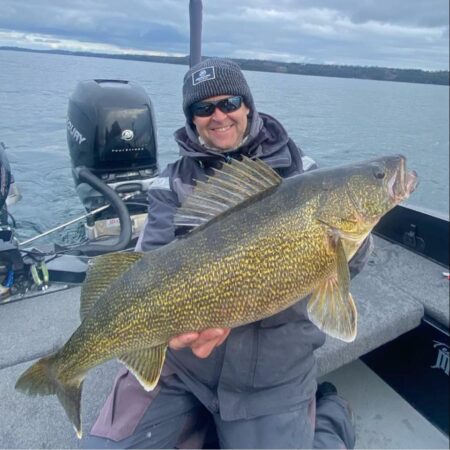
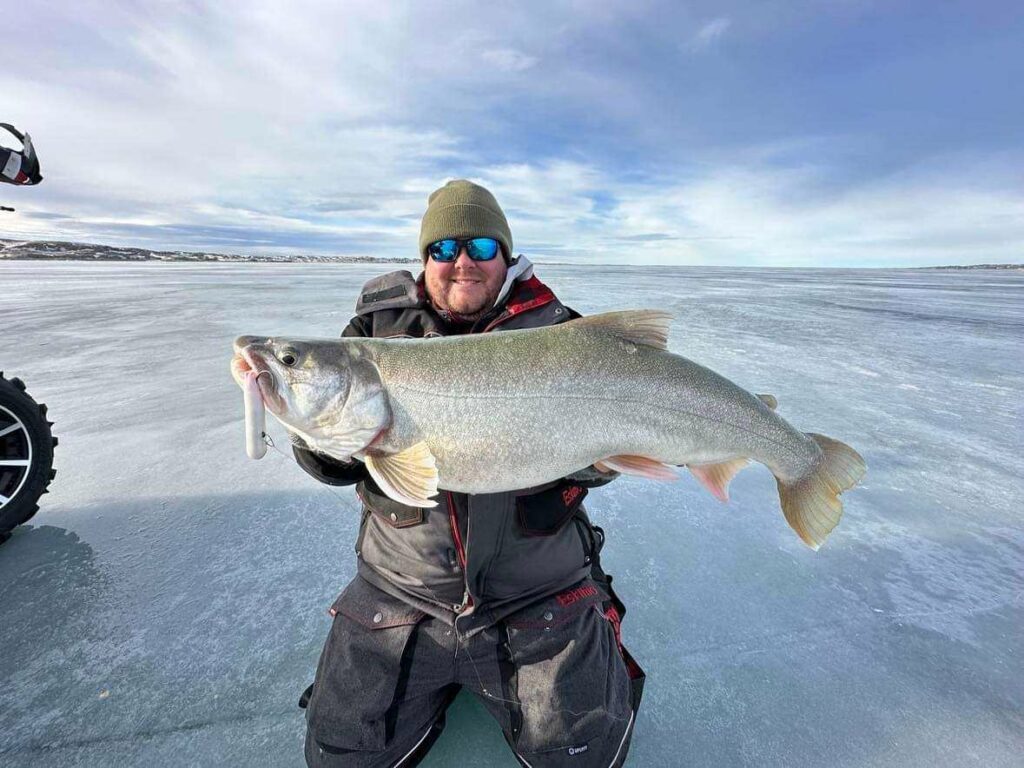
The lake trout bite can really turn on mid-ice through ice-out. Top destinations include Ontario lakes (Sunset Country); northern Minnesota lakes like Burntside and Snowbank; Fort Peck, Montana; and Lake Superior, although the latter can be tough to fish with sketchy ice conditions. There are high mountain lakes, too, that can be explored.
First thing about ice fishing lake trout is, you have to be prepared with a good on-ice machine. A lot of ice anglers have both a utility snowmobile and an ATV on-the-ready, depending on snow and slush conditions. Lake trout destinations aren’t typically accessible via truck, especially in late-season.
Many lake trout ice anglers prefer to hole hop outside, fishing in groups, but it’s always a good idea to tow a flip-over behind your machine, especially if the wind comes up, like in the conditions frequent to Fort Peck.
Ontario’s Sunset Country: Whitefish Bay (Lake of the Woods) & Crow Lake (Kakagi)
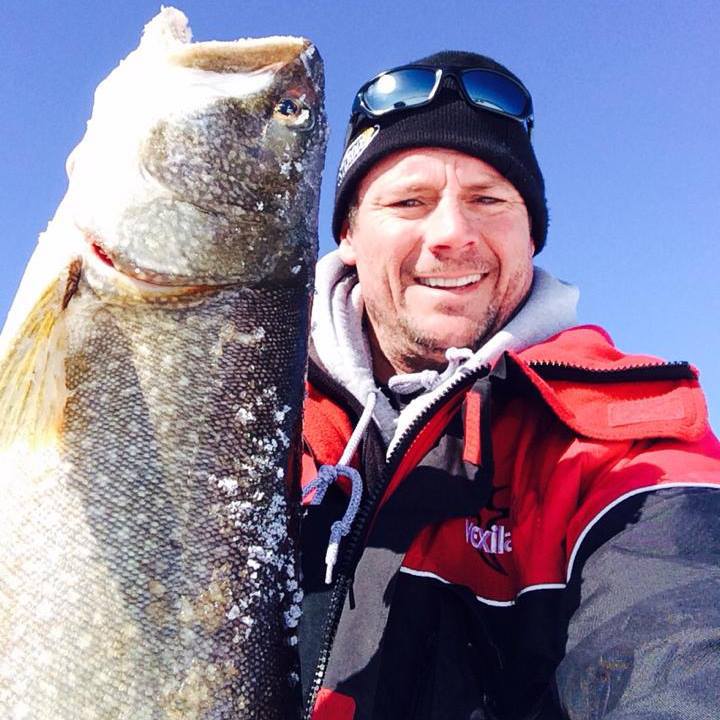
Bush pilot, former bait trapper, all-season fishing and hunting guide, and owner of Sunset Cove Resort in Nestor Falls, Ontario, Mike Gate, has fished hardwater lake trout for decades.
“Basically, my favorite time for ice lakers is late-February through mid-March—that’s when most of the snow seems to melt and it makes conditions easier to get around. You get more light penetration, too, which seems to turn the trout on,” offers Gate.
Gate says you don’t need anything special to fish ice lakers in Sunset Country.
“Make sure you’ve got your Vexilar or Humminbird, a handful of tube jigs, some blade baits, and drill a bunch of holes,” says Gate.
Recalling the late-ice laker bite of 2022, he says it was simply phenomenal. He’s hoping for the same this year.
“We went out the first weekend of March last year and there wasn’t enough snow for the snowmobiles and they’d start overheating. So, you’d drive until the snow machines got warm, drill some holes, and fish. Seemed like every spot we hit we’d catch two or three right off the bat. When the snow machines cooled down we’d hit next spot and do the same thing. We’d get upwards of 20-50 lake trout a day,” reports Gate.
Gate says the overall trout bite has gotten better over the past couple years.
“I love the weather from late-February through mid- to late-March. It’s not 30 below so the fishing is really comfortable. When I’m warm I function better.”
Where To Fish
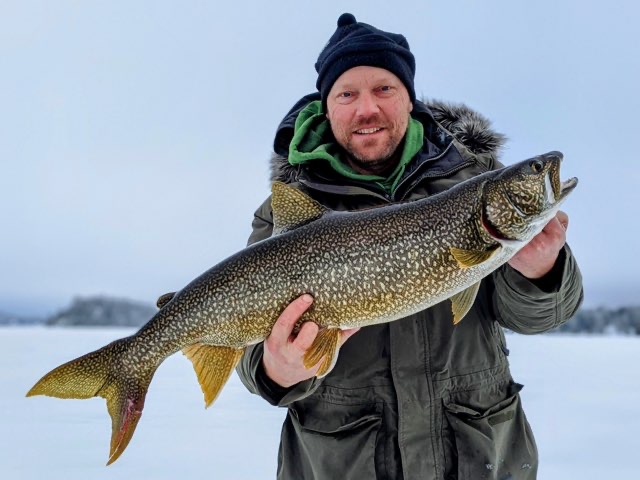
With Sunset Cove Resort located right in Nestor Falls, Gate is smack dab in the middle of a lot of great trout lakes.
“My main go-to spots are Whitefish Bay on LOTW and Crow Lake right across the road from our lodge. Most of the fish-producing areas are within a 15-minute ride by snowmobile from our place. If it’s a bad weather day for trout with wind, snow, or even rain, we can zip out right in front of the lodge and fish in one of our hard-houses for ample walleyes and crappies. You don’t need a full week up here to catch a lot of fish—three days is perfect,” says Gate.
“I don’t know if it’s being superstitious, but over the years I’ve honed in on the 40- to 42-feet zone for most of my mid- to late-ice lakers. That’s where I always start, but oddly enough, I’ve been moving up a lot shallower than I ever would have considered. Some days in 16 or 17 feet of water having a blast. It’s kind of been that way for me the last few years. I start deep and work shallower,” offers Gate.
Gate says he’s never had a lot of luck in the basins of either Whitefish or Crow, urging anglers to search out points, humps, and rock piles.
“Lake trout will be around these areas cruising around for something to eat, mainly ciscoes, whitefish, and even perch. There a couple spots on the Whitefish Bay where you’d swear there’s something wrong with your graph because there’s a five foot layer a foot off the bottom. At first we thought it was interference until we dropped our Aqua-Vu cameras and took a look. The bottom was loaded with perch. So we’d jig right above the masses or perch or rip bladebaits right through ‘em.”
Presentations & Set-Up
Like a lot of other winter lake trout anglers, a tube has been Gate’s long-time go-to bait, specially white with a red nose.
“While I still fish tubes, I’ve been fishing #4 Sebile Vibratos more and more. If we have chasing fish that won’t commit to a tube, when you tie on a Vibrato a fish will bite. The #4 Vibrato has a smaller profile than what we’ve typically used in the past—but I’ve sized down on everything. I use a heavy power 36” rod ice spinning rod spooled up with 15-pound braid and three feet of 8-, 10-, or 12-pound fluorocarbon. We’ve found that fishing a smaller blade bait and lighter test leader can actually produce more trout,” offers Gate.
Northern Minnesota: Outside & Inside BWCA
We talked with the DNR in Ely, Minnesota, to get the report on lake trout fishing on Burntside and Snowbank. Sounds like some fish are being caught by locals but there’s not a lot of beans being spilled. We did learn that there have been numerous anglers driving snowmobiles to the non-motorized border, parking their sleds, and snowshoeing into Basswood and other areas for largely untouched lake trout. Apparently BWCA’s aptly-named Trout Lake has been producing some nice fish, too. While flashers, graphs, and GPS units are allowed, anglers north of the non-motorized border must use hand augers to drill their holes.
Fort Peck Reservoir, Montana
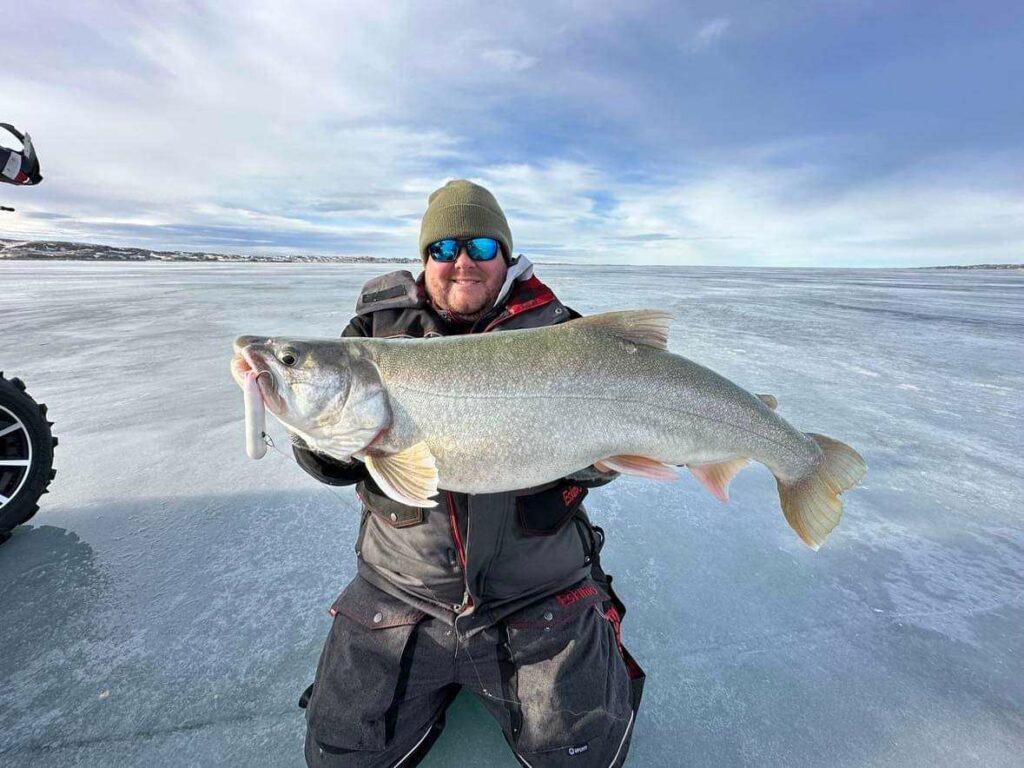
Garrison, ND-based ice angler, Tyrell Macheledt, just got back from Fort Peck Reservoir, Montana, on Tuesday, February 7th.
“We started fishing Fort Peck on Saturday, February 4th, starting at sun-up and fishing until sun-down. We caught nine lake trout on Saturday; nine on Sunday; and six on Monday. The biggest was 33-inches,” notes Macheledt.
“We marked a lot more fish but they were pretty negative. The other anglers we talked to said the same thing—everybody was marking a lot of trout but they were just chasing and not committing. They’d come in from the side—which we could see on LiveScope—but they just wouldn’t eat. But it’s just matter of time until the active bite starts up again,” says Macheledt.
In terms of depth, Ty and crew marked and caught the majority of their fish right around 60 feet of water.
Where to Fish on Fort Peck
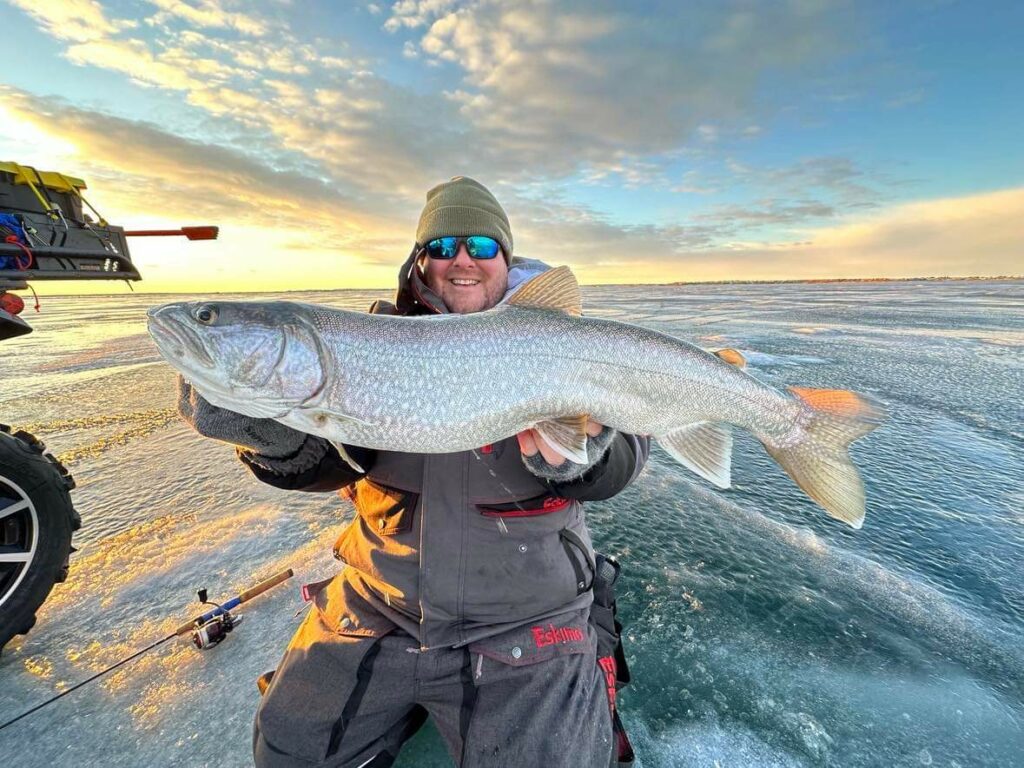
“You’ll see where the community spots are by the holes and even blood from some anglers who clean their fish on the ice,” divulges Macheledt.
“We typically try to get away from these areas but they’re a good starting point for anglers who’ve never fished the reservoir. Generally speaking, we like to fish the Dry Arm that starts by York Island—which is to the east side and runs all the way south. There are tons of points off of York Island, which is only 4 to 8 miles from the landing at Fort Peck Marina. We like to run about 20 miles each way to spots away from the Marina.”
Macheledt adds: “There are a lot heaves you have to navigate. We carry tri-fold ramps on our wheelers. We used them probably eight times this trip to reach spots. The heaves out there are like nothing I’ve ever seen before—some had two feet of open water between ‘em”
To cut down on costs, Ty and his buddy hauled out their own 18-foot Lodge Extreme II, which has three beds, a bathroom, and room to haul two ATVs and they camped right at the Fort Peck Marina, no generator required.
“We took our tracks off and switched back to tires before we left Garrison, because it’s pretty much bare ice on Fort Peck,” offers Macheledt.
Winning Presentations
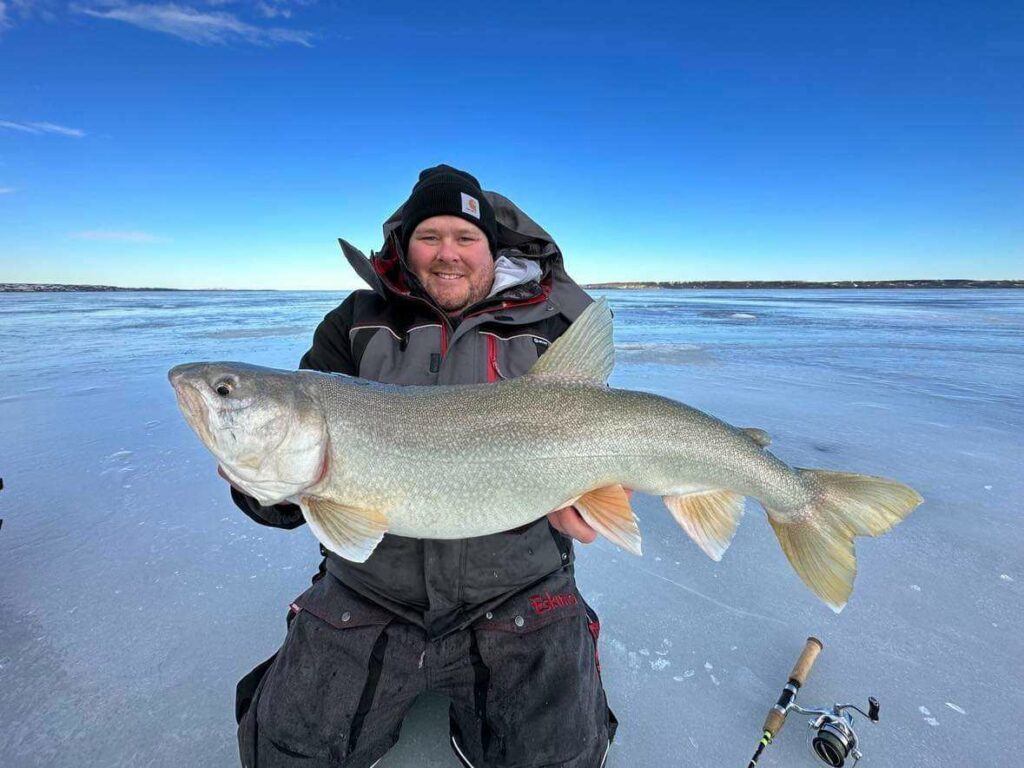
Over the years, Ty has tried every tube made. His favorites—5-inch Milk River Tubes out of Montana—are no longer in production. Macheledt bought hundreds when he heard the business was shutting down.
“When it comes to the potential for trophy fish on Fort Peck, I like 5-inch red and white tubes, with the red-colored plastic extending into the tail.”
The idea behind the 5-inch tube is to mimic the cisco forage in the Fort Peck fishery. “There’s no smelt above the dam. Sakakawea has smelt, but there aren’t any in Fort Peck, at least that I know of. The lakers are all eating big ciscoes,” offers Macheledt.
In terms of jig heads, Macheledt’s also tried everything over the years.
“I discovered some awesome jig heads from a company in Alaska called Kodiak Custom Fishing Tackle. Their 3/4-ounce Deluxe Trailer Hook & Bait Loop is the ultimate lake trout tube jig head. I rig the wire loop trailer with a size #2 Gamakatsu round-bend treble hook. The hook hangs just below the tube skirt,” shares Macheledt.
He says every lake trout caught on the recent trip was caught on the stinger, with the fish short-hitting every presentation dropped.
In terms rod & reel set-up, Macheledt fishes 15-pound braid and a 15-pound fluoro leader on a 42” Tuned Up Custom and a 45” Thorne Bros. Graphite Professional with 2500-size spinning reels.
“While we didn’t catch a ton of fish on this recent trip, we did get some good ones, so I’m happy. I’ll be back on Fort Peck March 1st (hopefully the ice holds) for what’s hopefully an even better bite!”
//.