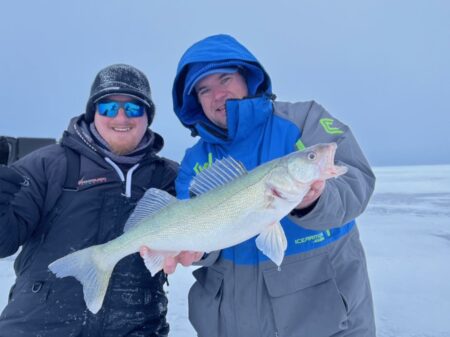
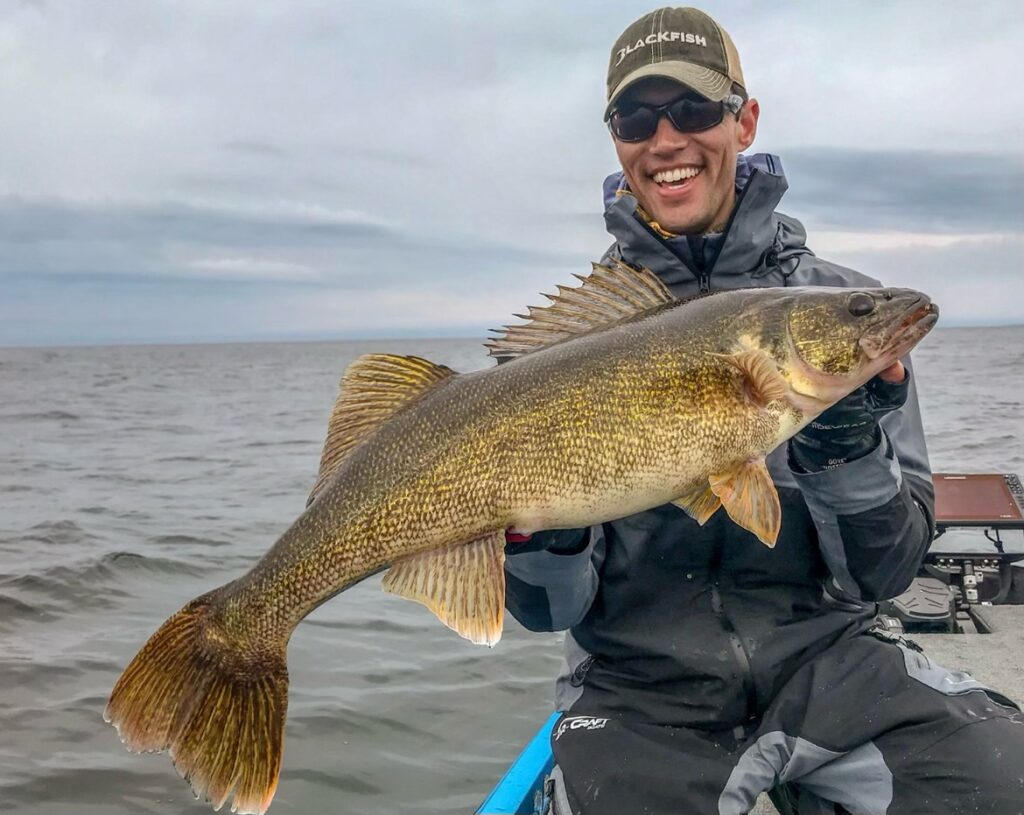
Joe Okada is a renowned Great Lakes walleye angler who has a reputation as an excellent troller with both crankbaits and harnesses. Okada also has a decorated career in competitive walleye fishing with several top finishes during his career on professional walleye tournament circuits. In this article, Joe shares some of his best walleye trolling tips to help you find more success on the water.
When walleye pull off structure and start living in the abyss, aka open water, the sheer expanse can be intimidating. Walleye anglers have to be able to eliminate water where there are no fish. The key to not only finding walleye but also determining how to set up in the water column happens when the boat is still on plane. “At trolling speeds or regular fishing speeds, the baitfish will sometimes push away from the boat or move deeper as you pass overhead,” explains Okada. This is why it is important to do your recon on plane, move across spots fast enough where the baitfish or predators don’t have time to adjust from the boat presence. According to Okada, this is one of the most important aspects of gather info for running your baits or lures at the right depth in the water column. On these high-speed graph passes which traditionally rely on standard 2D sonar, Okada makes a mental note of where in the water column he sees life and adjusts his trolling spread accordingly.
As a rule of thumb, lures or harnesses that are getting worked close to the bottom are worked off the boat while higher presentations are spread out away from the boat with inline planer boards. For most Great Lakes trolling patterns, walleye anglers deviate between crankbaits and spinner harnesses. Because both presentations require different speeds to work well, using both cranks and harnesses in the same trolling spread can be a challenge but Okada likes to mix both whenever possible. “I will commit to just harnesses or just cranks if I have to at times, but I like to make adjustments where I can keep both options in the spread at the same time as I feel I learn more and cover different bases, when possible,” stresses Okada.
Besides standard trolling speed which can affect how crankbaits and spinner harnesses perform in the water, walleye anglers on big water also have to account for current. “I like to push my spinner harnesses to the max in regard to speed at times and find that when the blades do a little stutter flutter at the top end of the speed range is a very powerful trigger.” How lures work however can be greatly affected by current. There are devices today like Fish Hawks that show you current speed below the boat, but some visual indications can also be seen without any extra equipment. “I always like to put the crank or harness next to the boat and watch the action. You will notice big changes between going against a head wind versus turning around and going with the current or cross current. Sometimes we have to speed up or slow down to get the right action regardless of what the ground speed on the GPS says,” explains Okada.
Another telling sign of current is often on the planer boards themselves. All of the planer boards should be marching in a line and if a board starts to sag or the boards become uneven, you are probably going against the current. Okada often drops his trolling speeds down when going against the current and speeds up when going with the current.
When using harnesses, Okada is a fan of the deep cup Colorado blades even though many Great Lakes anglers rely prominently on willow leaf blades. Okada likes the lift and the depth control that Colorado blades have where he believes the fall and rise of the harness changing speeds is a powerful trigger. At faster speeds however, when Okada wants to keep a few harnesses next to crankbaits, Okada will often use harnesses tied with two small tandem willow leaf blades to handle the faster speeds. On both crankbait and harness setups, straight ten-to-twelve-pound monofilament is used for both presentations.
Okada believes he gets more information whenever he can run both crankbaits and spinner harnesses in the same spread. “You will see fish respond to different presentations through the course of the day. There are times when we might get numbers of fish on the harnesses while the big fish might take the cranks or vice versa. I never like to put all of my eggs in one basket, if possible,” stresses Okada. To accomplish this task, Okada makes small compromises and pushes some presentations to the edge of the speed range so that he can keep contrasting offerings in the water in front of fish.
Be sure to check out our walleye database for more real-time intel here.